The landscape of digital content creation is undergoing a seismic shift. What once felt like a distant, glitchy dream of AI-generated video has, with the advent of OpenAI Sora 2, become a cinema-grade reality. We’re no longer talking about fleeting, artifact-laden clips, but cohesive, visually stunning narratives capable of transforming entire industries.
As of December 2025, Sora 2 is not just a concept; it’s a live, accessible tool for OpenAI’s premium subscribers, with a dedicated Sora iOS App further democratizing access. This article cuts through the hype to provide Content Creators, Marketers, and Enterprise Tech Leaders with a definitive guide to accessing Sora 2, understanding its intricate pricing structure, and navigating the groundbreaking—and controversial—new ‘Cameos’ feature.
Introduction: The Era of World Simulators
OpenAI’s Sora 2 represents a monumental leap in artificial intelligence, moving beyond mere content generation to what researchers are calling ‘World Simulation.’ This isn’t just about creating video; it’s about modeling complex physical interactions and narrative coherence within a virtual environment. The implications for film, advertising, and even scientific research are profound, offering unprecedented tools for visual storytelling and rapid prototyping.
Release Date Timeline: When Did Sora Actually Launch?
The journey to Sora 2 has been swift and impactful. The initial preview of Sora 1 captivated the tech world when it was first announced in February 2024, promising a new frontier in video generation. A public beta quickly followed on December 9, 2024, giving early adopters a taste of its capabilities.
However, the true game-changer arrived on September 30, 2025, with the official release of Sora 2. This flagship version swiftly became the standard, eclipsing its predecessor with vastly improved fidelity and features. While widely available in the US and Canada, the UK and EU have experienced rollout delays, primarily due to complex regulatory frameworks like GDPR and the pending EU AI Act, which mandate stringent data privacy and ethical AI guidelines.
Sora 2 vs. Sora 1: Key Feature Upgrades
The leap from Sora 1 to Sora 2 is not incremental; it’s a paradigm shift. Content creators will immediately notice several critical improvements:
- Audio Synchronization: Perhaps the most impactful upgrade, Sora 2 now generates contextually relevant sound effects and even dialogue directly synchronized with the visual content. Sora 1, by contrast, produced silent videos, requiring laborious manual audio integration.
- Resolution & Duration: While Sora 1 was limited to 480p resolution and clips of up to 5 seconds, Sora 2 elevates the standard significantly. ChatGPT Plus subscribers can generate videos up to 720p for 10 seconds, while ChatGPT Pro users unlock full 1080p Resolution and durations of up to 20 seconds, offering much richer creative canvases. This increased fidelity is made possible by a refined Diffusion Transformer architecture.
- Cameos Feature: This groundbreaking addition allows users to scan themselves or other approved individuals into generated scenes. It’s a powerful tool for personalized content but has already sparked controversy, leading to a notable ‘Cameo’ trademark lawsuit.
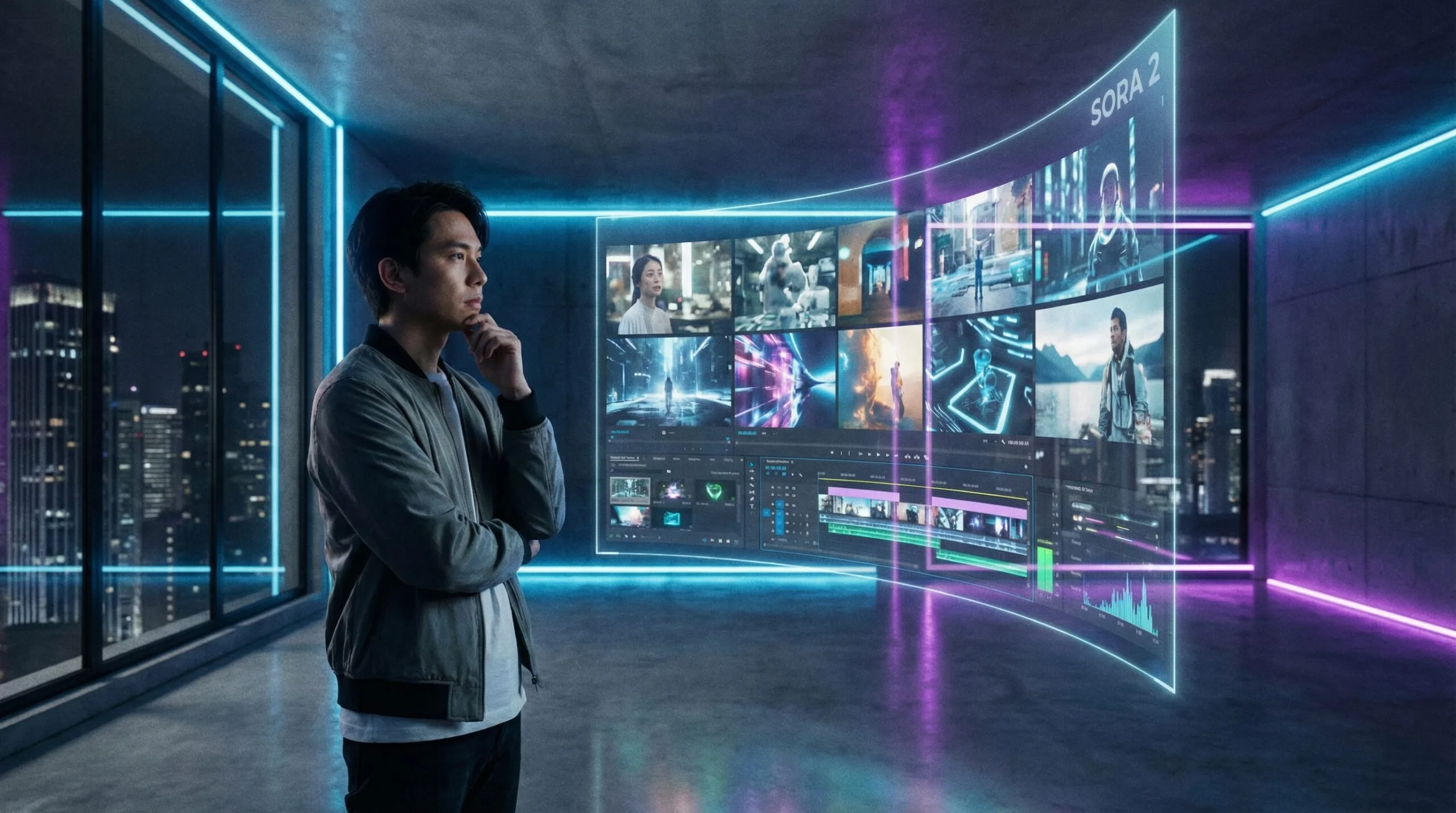
- Editing Tools: Sora 2 introduces a suite of integrated editing functionalities. The ‘Recut‘ feature offers a timeline-based editor, allowing precise manipulation of generated clips. ‘Remix‘ takes style transfer to a new level, enabling users to apply the aesthetic of one video to another, or even generate variations of a single scene with different visual styles. These tools significantly reduce the need for external video editing software.
How to Access OpenAI Sora (Step-by-Step)
Gaining access to Sora 2 is straightforward, provided you meet the subscription requirements:
- Subscription Requirement: Sora 2 is not a standalone product; it’s integrated into the OpenAI ecosystem. You will need either a ChatGPT Plus subscription ($20/month) or, for more advanced capabilities, a ChatGPT Pro subscription ($200/month).
- Platform Access: Once subscribed, you can access Sora 2 directly via the official website, sora.com. Alternatively, the dedicated Sora iOS App offers a streamlined mobile experience for on-the-go video generation. An Android version is reportedly in development.
- The ‘Credit’ System Explained: Your subscription tier dictates your video generation capacity. ChatGPT Plus grants approximately 50 video credits per month, with standard processing speeds. ChatGPT Pro users enjoy a significantly higher allocation, typically 500+ priority videos per month, alongside faster generation times and access to premium features like 1080p Resolution.
- Troubleshooting: ‘Not available in your country’: For users outside the initial US/Canada rollout, you might encounter region lock messages. While some users explore VPN workarounds, proceed with caution. OpenAI actively monitors for VPN usage, and circumvention can lead to account suspension. Official expanded region availability is continuously being announced on OpenAI’s news channels.
Interactive Tool: Is ChatGPT Pro Worth It for Video?
Deciding between ChatGPT Plus and Pro for Sora 2 access can be a critical financial decision for content creators. Use our simple estimator below to gauge which tier best suits your video generation needs.
Video Generation Cost Estimator
Under the Hood: How Sora Simulates Reality
Beneath its user-friendly interface, Sora 2 is an engineering marvel. Its core functionality is built upon an innovative architecture known as a Diffusion Transformer. Unlike previous generative models that might struggle with temporal consistency, Sora breaks down video content into what OpenAI refers to as ‘spacetime patches.’ These patches are analogous to tokens in large language models but capture both spatial (pixel data) and temporal (motion over time) information.
This sophisticated approach allows Sora 2 to achieve genuine World Simulation. It doesn’t just animate pixels; it understands and predicts how objects interact within a simulated environment, adhering to principles of gravity, inertia, and object permanence. While not always perfect, this foundational understanding is why Sora 2 can generate such uncannily realistic scenes. The model employs sophisticated Frame Interpolation techniques to ensure smooth, natural motion between generated keyframes.
Safety and ethics are paramount. All content generated by Sora 2 comes with mandatory C2PA Metadata embedded within the file. This digital watermark provides an immutable chain of custody, indicating that the video is AI-generated and detailing its origin. Furthermore, OpenAI employs extensive Red Teaming efforts, where experts actively try to prompt the model into generating harmful or biased content, helping to identify and mitigate potential misuse before it reaches the public.
Advanced Tips for Better Prompts
Mastering Sora 2, like any powerful AI, hinges on effective prompt engineering. Here’s how to elevate your video generation:
- Using the ‘Storyboard’ Feature: For multi-shot narratives, the integrated Storyboard Tool is invaluable. Instead of a single long prompt, create a sequence of prompts for different shots. You can specify camera angles, character actions, and scene transitions, allowing Sora to build a more complex narrative arc.
- Prompt Engineering for Visual Detail: Be precise with visual details. Specify camera lenses (e.g., ’35mm anamorphic wide-angle shot,’ ‘macro lens close-up’), lighting conditions (‘golden hour backlight,’ ‘noir-style low-key lighting’), and textures (‘wet cobblestone street,’ ‘aged leather’). The more descriptive you are, the better Sora can render your vision.
- Aspect Ratios: Always specify your desired aspect ratio. ‘Vertical (9:16) for TikTok,’ ‘Horizontal (16:9) for YouTube,’ or ‘Square (1:1) for Instagram’ are common options. This ensures your output is immediately optimized for its target platform.
Controversy: The ‘Reality Collapse’ & Copyright Wars
Sora 2, for all its brilliance, is not without its detractors and controversies. The rapid advancement of AI video generation has ignited passionate debates across various sectors.
- The Japanese Anime Crisis: ‘Thiefware’?: A significant backlash has emerged from the Japanese creative industry, particularly from studios like Ghibli and major broadcasters. Concerns abound that Sora 2 could be