Sora vs. Runway Gen-3 vs. Pika: The Ultimate AI Video Showdown (2025 Benchmarks)
Introduction: The ‘Trifecta’ of Generative Video
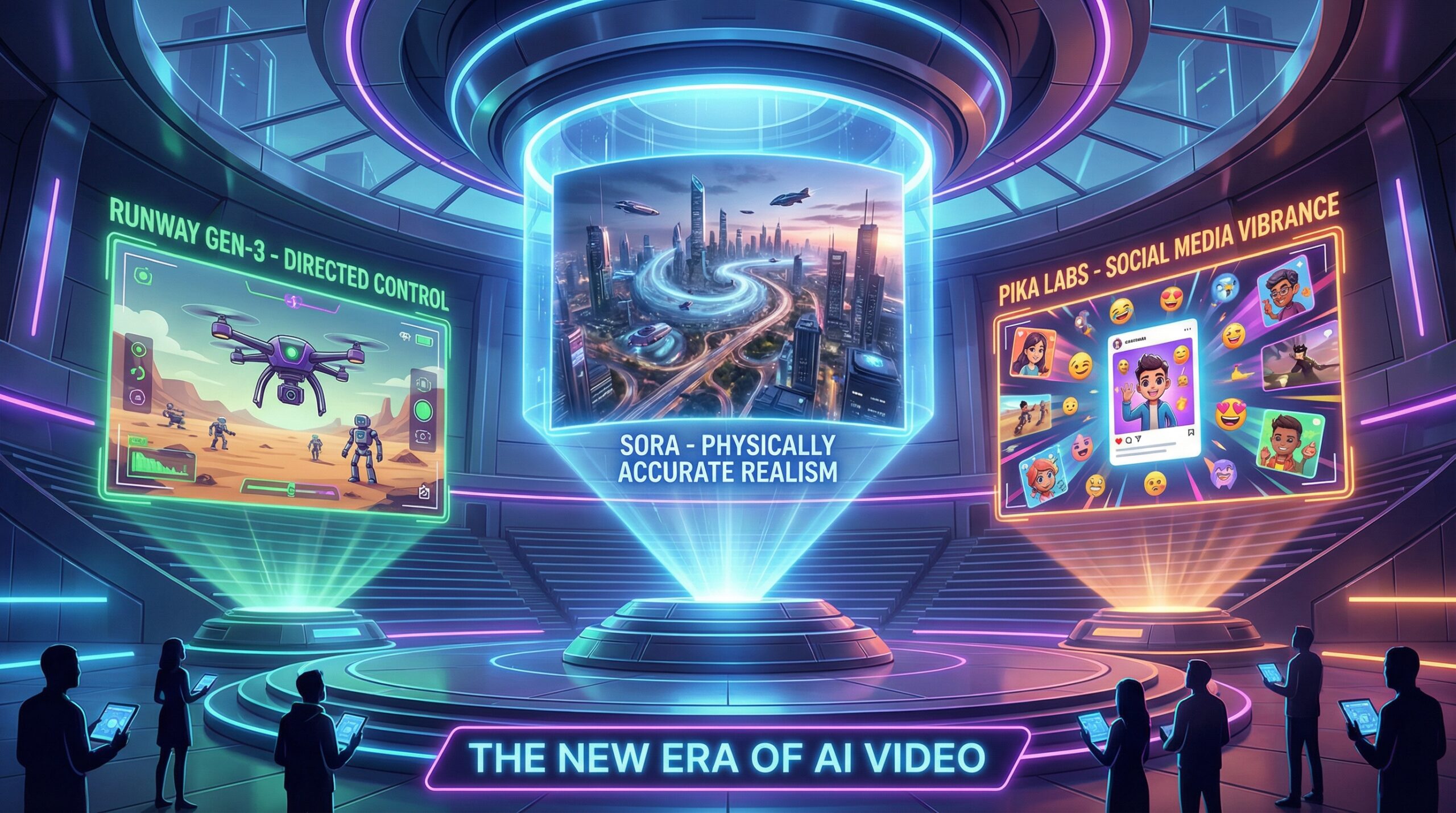
Remember the early days of AI video? Glitchy GIFs and uncanny valley experiments that were more novelty than utility. Fast forward to 2025, and we’re witnessing a seismic shift towards Hollywood-grade B-roll and increasingly sophisticated narrative generation. The promise of enterprise AI video generation software is now tantalizingly close, but the landscape is fractured, dominated by three titans: OpenAI’s Sora, RunwayML’s Gen-3 Alpha, and Pika Labs. Each offers a distinct approach, targeting different segments of the creative market. Sora, the ‘Physicist,’ aims for unparalleled realism and adherence to physical laws. Runway Gen-3, the ‘Director,’ prioritizes granular control over camera, subject, and scene. Pika, the ‘Socialite,’ focuses on speed and accessibility for rapid content creation. For marketing directors, video editors, and content creators at the decision stage, choosing the wrong tool isn’t just a matter of preference; it costs hours in render time, wasted credits, and ultimately, missed opportunities. This showdown will dissect their capabilities, costs, and real-world applicability to help you make an informed choice.
Table of Contents
- Introduction: The ‘Trifecta’ of Generative Video
- Feature Face-Off: The Technical Benchmarks
- The ‘Physics’ Test: Realism vs. Hallucination
- Pricing & Credit Economy: Which One Bankrupts You?
- Workflow Integration: From Prompt to Premiere Pro
- The Contrarian Corner: The ‘Hype vs. Production’ Reality
- Verdict: Which Tool Matches Your DNA?
- FAQ: Your Budget & Legal Questions Answered
Feature Face-Off: The Technical Benchmarks
What is Temporal Consistency and why is it critical for AI video?
Temporal Consistency refers to an AI video model’s ability to maintain the identity, appearance, and physical properties of objects and characters across multiple frames. Without strong temporal consistency, objects can unpredictably morph, disappear, or reappear, leading to visually jarring and unrealistic outputs. It’s crucial for generating believable, high-quality video content.
When evaluating generative video tools, raw pixel quality is only part of the story. The true differentiator often lies in how well the AI maintains continuity across a sequence of frames. Sora demonstrates a significant lead in **Temporal Consistency**, thanks to its foundation in advanced **Diffusion Transformer Models**. Unlike earlier generative AI that struggled with object permanence, Sora’s understanding of 3D space and physics allows it to keep elements consistent, avoiding the infamous ‘disappearing limbs’ issue or objects morphing inexplicably. For nuanced scenes, this makes all the difference, creating a much more believable output from the initial prompt adherence.
Runway Gen-3 Alpha, while still powerful, leverages sophisticated **Motion Brush Control** and a dedicated ‘Director Mode’ to compensate. These features empower users to define specific regions of an image and dictate their movement, offering unparalleled **Camera Path Customization**. This gives editors a director-like command over the scene, a crucial advantage when precise storytelling is paramount. Pika, while rapidly improving, still prioritizes speed. Its lightning-fast rendering makes it ideal for iterative design and rapid prototyping for platforms like TikTok, where the overall quality bar is often secondary to timely, trend-driven content. However, this often comes at the expense of intricate **Physics Simulation Engine** capabilities and ultra-fine detail, though **Frame Interpolation** techniques are improving its smoothness.
When it comes to **Audio Integration**, none of these platforms currently offer robust, native sound generation that rivals dedicated audio synthesis tools. Most still require external audio track additions, though efforts are underway to integrate more sophisticated lip-sync accuracy for talking head videos.
The ‘Physics’ Test: Realism vs. Hallucination
The ultimate litmus test for any advanced AI video model is its ability to simulate real-world physics. Early models notoriously failed at depicting fluid dynamics – water sloshing unrealistically, fire behaving like a static texture. Sora, with its deep understanding of object interactions and a robust **Physics Simulation Engine**, excels here. Whether it’s the ripple of water, the flicker of a flame, or the crumpling of paper, Sora generates remarkably convincing natural phenomena, a testament to its comprehensive **Latent Space Rendering** capabilities that encode complex real-world dynamics. This is why it often sets the benchmark for realistic **Render Time vs. Quality** expectations.
Consider the ‘bite’ test: how each model handles an object changing state, for instance, a person taking a bite out of a hamburger. Sora typically manages this with high fidelity, showing realistic deformation and consumption. Runway Gen-3 has made significant strides in this area, particularly with more defined prompts and **Motion Brush Control**, allowing artists to guide the interaction. Pika, while improving, still shows occasional **Upscaling Artifacts** and less granular control over such complex physical interactions, often prioritizing rapid generation over perfect physical accuracy. Sora’s unique advantage lies in its capacity to grasp the underlying 3D structure and interactions of objects within a scene, making it unparalleled for complex, high-realism concepts that demand deep **Prompt Adherence** to physical laws.
Pricing & Credit Economy: Which One Bankrupts You?
How do AI video generation costs compare across platforms?
AI video generation costs vary significantly based on model complexity, desired quality, and platform. Runway Gen-3 utilizes a credit system, Pika Labs offers tiered subscriptions with credit top-ups, and Sora’s commercial model is still being defined but is expected to be premium. Factors like resolution, frame rate, and video length directly impact the ‘cost per second’ of generated content, making budget planning crucial for users.
Understanding the economics of AI video generation is paramount for marketing directors and content creators. Runway Gen-3 Alpha operates on a credit consumption model, where higher resolution, longer duration, and more complex generations (e.g., using Director Mode) consume more credits. This model demands careful budget planning, especially for **Batch Processing** of multiple video assets. Pika Labs offers a more traditional tiered subscription model with varying monthly credit allocations, allowing for additional credit top-ups as needed. Its focus on speed often translates to a lower ‘cost per second of video’ for quick, social-ready clips, making it appealing for frequent, lower-fidelity output.
Sora’s commercial license model is still largely speculative, as it remains in limited access. However, given its unparalleled quality and computational demands, it’s widely anticipated to be a premium offering, potentially with a ‘token’ or ‘compute unit’ cost structure that reflects its advanced capabilities and extensive **Physics Simulation Engine** usage. For enterprise AI video generation software applications, understanding this cost structure will be crucial. We can expect OpenAI Sora commercial license terms to reflect its position at the pinnacle of AI video realism.
To illustrate the potential impact on your budget, here’s a conceptual calculator:
AI Video Cost Estimator (Conceptual)
This calculator is a placeholder for a more robust tool, designed to help you estimate the ‘Cost Per Second of Video’ based on hypothetical rates and your specific project needs. In a real-world scenario, such a tool would integrate live pricing APIs from each platform.
Estimated Total Cost: $0.00
Workflow Integration: From Prompt to Premiere Pro
Seamless integration into existing video production pipelines is crucial for professionals. Runway Gen-3 offers robust export options, including higher-bitrate MP4 and even ProRes formats, making it a strong contender for video editors working within Adobe Premiere Pro or DaVinci Resolve. The ability to export in professional codecs minimizes the need for transcoding and preserves quality, crucial when dealing with **Upscaling Artifacts** that might appear when going from 720p to 4K. Runway’s focus on granular control also translates to better starting points for post-production work.
Pika Labs typically exports in standard MP4 formats, optimized for web and social media. While perfectly adequate for its target audience, it may require additional steps for professional-grade workflows. **Aspect Ratio Native Support** is generally good across all platforms, but only a few offer comprehensive options beyond standard cinematic ratios without requiring additional processing.
For developers, **API Access** is a key consideration. Runway leads the pack with a well-documented API, positioning it as the best text-to-video API for developers looking to build custom applications or integrate generative video into larger automation workflows. While Pika has developer-focused features, and Sora is expected to offer enterprise-level API access in the future, Runway currently holds an edge for immediate integration and custom solution development. This is particularly relevant for creating custom tools for **Batch Processing** large volumes of content, such as generating localized marketing videos at scale.
The ‘Hype vs. Production’ Reality
Why is Sora’s commercial availability a major hurdle for users?
Despite its groundbreaking capabilities, Sora’s limited, invite-only access makes it effectively ‘vaporware’ for the average user or commercial entity. Unlike readily available tools like Runway or Pika, Sora’s lack of a public release or clear commercial licensing model creates an availability gap, meaning even if it’s technically superior, it’s not a viable production tool for most businesses in 2025.
Let’s be blunt: the hype surrounding AI video often overshadows its practical production utility. While the demonstrations are stunning, the reality is that 80% of AI-generated video, even from advanced models, still requires significant human intervention or is unusable for final cuts due. The ‘Sora Availability’ gap is perhaps the most significant bottleneck no one talks about. While Sora generates the best headlines and pushes the boundaries of what’s possible, its limited, invite-only access makes it effectively ‘vaporware’ for the average marketing director or video editor looking for a reliable, production-ready tool. The best tool, as the saying goes, is the one you can actually use.
This is where Runway Gen-3 and Pika shine: they are accessible. For now, the most reliable and safe commercial use case for AI video remains B-roll generation, visual effects augmentation, and rapid prototyping. Generating entire narrative sequences with perfect **Lip-Sync Accuracy**, emotional depth, and zero **Upscaling Artifacts** without significant human touch-up is still largely aspirational. Businesses must carefully evaluate the **Commercial Usage Rights** and consider the emerging **C2PA Provenance** standards to ensure their AI-generated content is ethically sourced and legally sound, minimizing risks associated with deepfakes or misinformation.
Verdict: Which Tool Matches Your DNA?
Key Takeaways:
- For Filmmakers & Agencies: Runway Gen-3 Alpha. Offers the most granular control, professional export formats (ProRes), and API access for complex workflows. It’s the pragmatic winner for those needing precise direction.
- For Social Media Managers & Content Creators: Pika Labs. Prioritizes speed and accessibility, making it perfect for rapid iteration, trending content, and high-volume, lower-fidelity outputs for platforms like TikTok.
- For High-End Concepts & Research: Sora. Unmatched in realism, temporal consistency, and physics simulation. However, its limited availability makes it a tool for pioneering experiments rather than immediate commercial production.
Choosing the right AI video tool in 2025 isn’t about finding a single ‘best’ option, but rather the one that aligns with your specific workflow, budget, and creative ambitions. If you demand granular **Camera Path Customization**, extensive **Motion Brush Control**, and seamless integration into professional editing suites, Runway Gen-3 is your pragmatic winner. It provides the control a director needs.
If speed, accessibility, and generating high volumes of engaging, trend-driven content for social media are your priorities, Pika Labs offers an unbeatable value proposition. It’s the socialite of the group, ready to create viral moments.
And then there’s Sora. For those pushing the boundaries of realism, exploring complex **Physics Simulation Engine** scenarios, and demanding the utmost in **Temporal Consistency** and **Prompt Adherence**, Sora represents the ultimate aspirational tool. However, until its OpenAI Sora commercial license becomes widely available, it remains a tantalizing glimpse into the future rather than a present-day production workhorse.
FAQ: Your Budget & Legal Questions Answered
What are the commercial rights and copyright considerations for AI-generated video?
Commercial rights for AI-generated video vary by platform. Users must review each service’s terms of use, particularly regarding monetization and ownership. Copyright attribution for purely AI-generated works is currently a complex legal area, with many jurisdictions leaning towards human authorship. Adherence to C2PA provenance standards is becoming crucial for verifying content authenticity and origin.
Q: Can I use AI-generated videos for commercial purposes?
A: Yes, but with caveats. Always review the specific terms of service for each platform regarding **Commercial Usage Rights**. Runway and Pika generally offer commercial licenses with their paid tiers. OpenAI’s policy for Sora’s commercial usage is still under development, but will likely involve specific licensing agreements.
Q: How do AI video models address copyright and C2PA Provenance?
A: Copyright for AI-generated content is a rapidly evolving legal landscape. Most current legal frameworks lean towards human authorship. However, all major players are exploring or implementing **C2PA Provenance** standards. This technology embeds cryptographic metadata into content to verify its origin and any AI modifications, helping to combat misinformation and ensure transparency.
Q: What are the hardware requirements for running these AI video tools?
A: All three discussed platforms are cloud-based, meaning you don’t need powerful local hardware to generate videos. The heavy computational lifting, including **Latent Space Rendering** and complex **Diffusion Transformer Models**, is done on their remote servers. Your primary requirement is a stable internet connection and a device capable of running a web browser, making them accessible to a wide audience regardless of their local computing power. Your **Render Time vs. Quality** settings will, however, affect the server-side processing load.