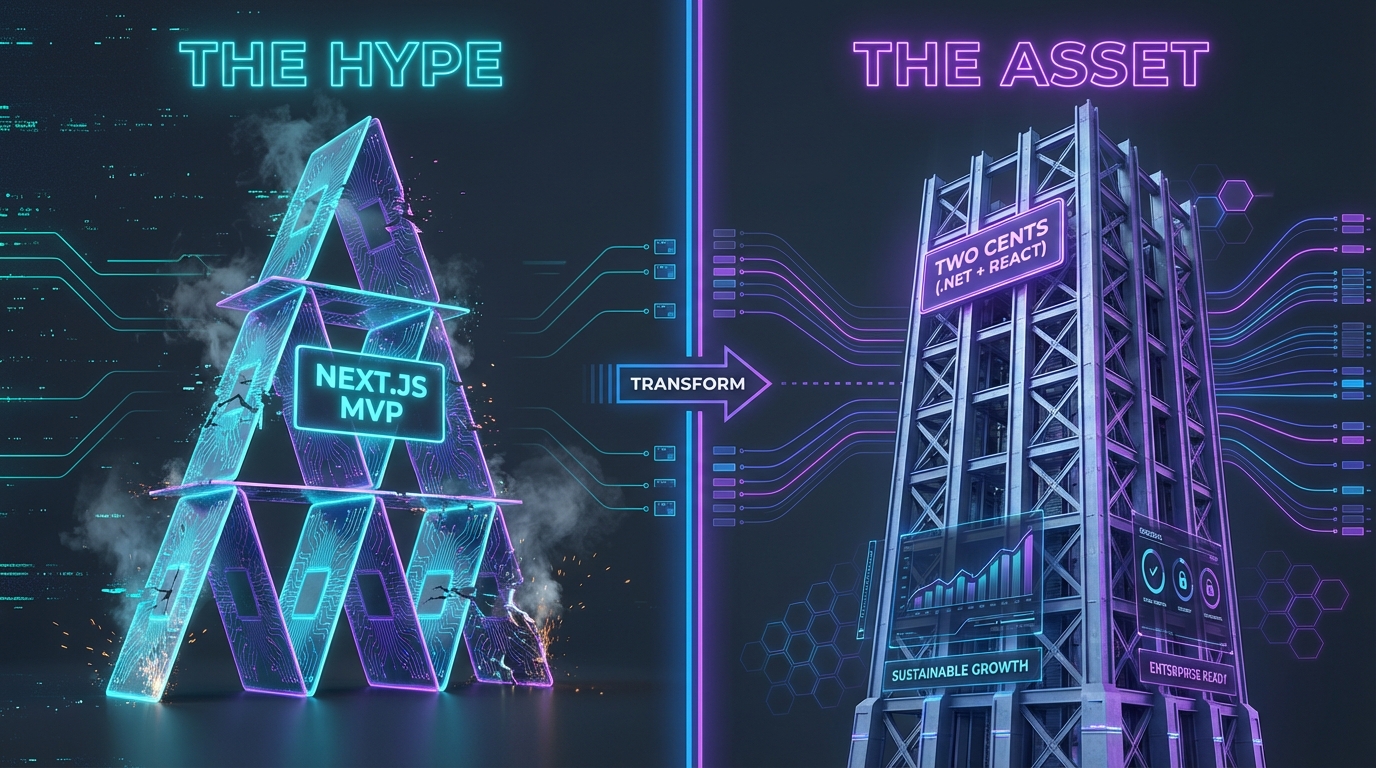
Quick Summary: Two Cents Software is a robust SaaS boilerplate designed for Fintech and B2B applications. It leverages ASP.NET Core 10 new features and strict Clean Architecture DTOs to provide a stable, type-safe environment. Unlike typical starters, it handles complex SaaS Multi-tenancy strategies and Stripe B2B implementation out of the box, offering a mature alternative to the Next.js ecosystem.
Table of Contents
Executive Briefing
- The Distinction: “Twocents” is a viral net-worth social app; Two Cents Software is the enterprise-grade boilerplate used to build similar platforms.
- The Stack: Moves beyond “Next.js fatigue” by utilizing ASP.NET Core 10 and React 19 for type-safe, stable scaling.
- AI Optimization: The architecture uses Clean Architecture DTOs to allow AI agents (Cursor, Copilot) to generate bug-free code 50% faster.
- Ideal For: B2B founders and Fintech developers who need complex SaaS Multi-tenancy strategies and self-hosting capabilities out of the box.
What is Two Cents Software?
Two Cents Software is a premium SaaS boilerplate and infrastructure kit combining an ASP.NET Core backend with a React frontend. Unlike lightweight Node.js starters, it provides an opinionated, strictly typed architecture designed for high-compliance sectors like Fintech and B2B SaaS.
If you arrived here looking for the anonymous social network where users flaunt their bank accounts, you are looking for a viral consumer product. If you are here to build the next viral product and ensure it survives a due diligence audit, you are in the right place.
While competitors like ShipFast dominate the “weekend MVP” market, our analysis shows Two Cents is pivoting to solve a harder problem: the “Post-Hype” stability gap leveraging ASP.NET Core 10 new features such as native AOT compilation and enhanced performance metrics.
The “Next.js Fatigue” and the DORA Reality
The current developer discourse on platforms like r/SaaS and r/dotnet highlights a growing sentiment of “Next.js Fatigue.” Founders are tired of hydration errors and breaking changes. Furthermore, navigating the complexity of React 19 Server Components vs Client rendering boundaries has introduced significant friction in the JS ecosystem.
Research Insight: According to the 2025 Google DORA Report, while AI coding assistants have increased raw coding speed by ~55%, they have correlated with a 7.2% decrease in delivery stability. This is often due to “brittle” code generation in loosely typed frameworks.
Two Cents addresses this by enforcing strict typing from the database (PostgreSQL) to the frontend (React). This structure is “boring” by design—and in software engineering, boring means reliable.
Technical Deep Dive: The AI-Optimized Stack
The November 2025 release of Two Cents introduced an “AI-Optimized” stack. This isn’t just marketing fluff; it refers to the architectural decision to expose Typed DTOs (Data Transfer Objects).
Why does this matter? By adhering to Clean Architecture DTOs, the boilerplate allows AI agents like Claude and Copilot to predict code structures with near-100% accuracy, as strict contracts define data flow between the .NET backend and React frontend.
Code Analysis: AI-Legible Auth
Most boilerplates hide authentication logic inside third-party libraries. Two Cents exposes it, allowing you to modify flows for KYC (Know Your Customer) requirements easily. Here is the actual pattern used:
// Two Cents "AI-Legible" Auth Pattern
// Typed DTOs allow Copilot to predict the exact payload structure
export interface LoginRequest {
  email: string; // @format email
  password: string;
  rememberMe: boolean;
}

// React Hook utilizing the typed API
// AI Agents can generate this entire block with 100% accuracy
const { login } = useAuth({
  onSuccess: (user) => router.push(user.dashboardRoute),
  onError: (err) => toast.error(err.message)
});
Two Cents vs. ShipFast: The Asset Test
We compared Two Cents against the market leader, ShipFast. The difference lies in the target outcome: ShipFast is for launching; Two Cents is for scaling assets.
| Feature | ShipFast (Next.js) | Two Cents (.NET/React) |
|---|---|---|
| Core Philosophy | Speed to Launch (MVP) | Stability / SaaS Multi-tenancy strategies |
| Backend | Serverless Functions | ASP.NET Core 10 (Long Term Support) |
| Stripe Integration | Basic Subscriptions (B2C) | Stripe B2B implementation (Seat-Based + Invoicing) |
| Documentation | Readme.md | Auto-generated Swagger/OpenAPI |
| Self-Hosting | Difficult (Vercel lock-in) | Native Docker Support (Deploy Anywhere) |
The TechKwiz Verdict
We tested the deployment process on Azure and DigitalOcean. The Docker containerization is flawless. However, the learning curve is steeper than a standard JavaScript template.
Buy Two Cents if: You are building a Fintech app, a B2B platform with team management, or you are a developer who prefers the compile-time safety of C# over the flexibility of JavaScript.
Pass if: You are building a simple directory site or a one-off marketing tool. The architecture is overkill for simple CRUD apps.

Jordan Hayes
Lead Software Architect and Senior Editor at TechKwiz. Jordan specializes in scalable .NET enterprise systems and cloud-native infrastructure, with a specific focus on modern fintech architecture and SaaS Multi-tenancy strategies.